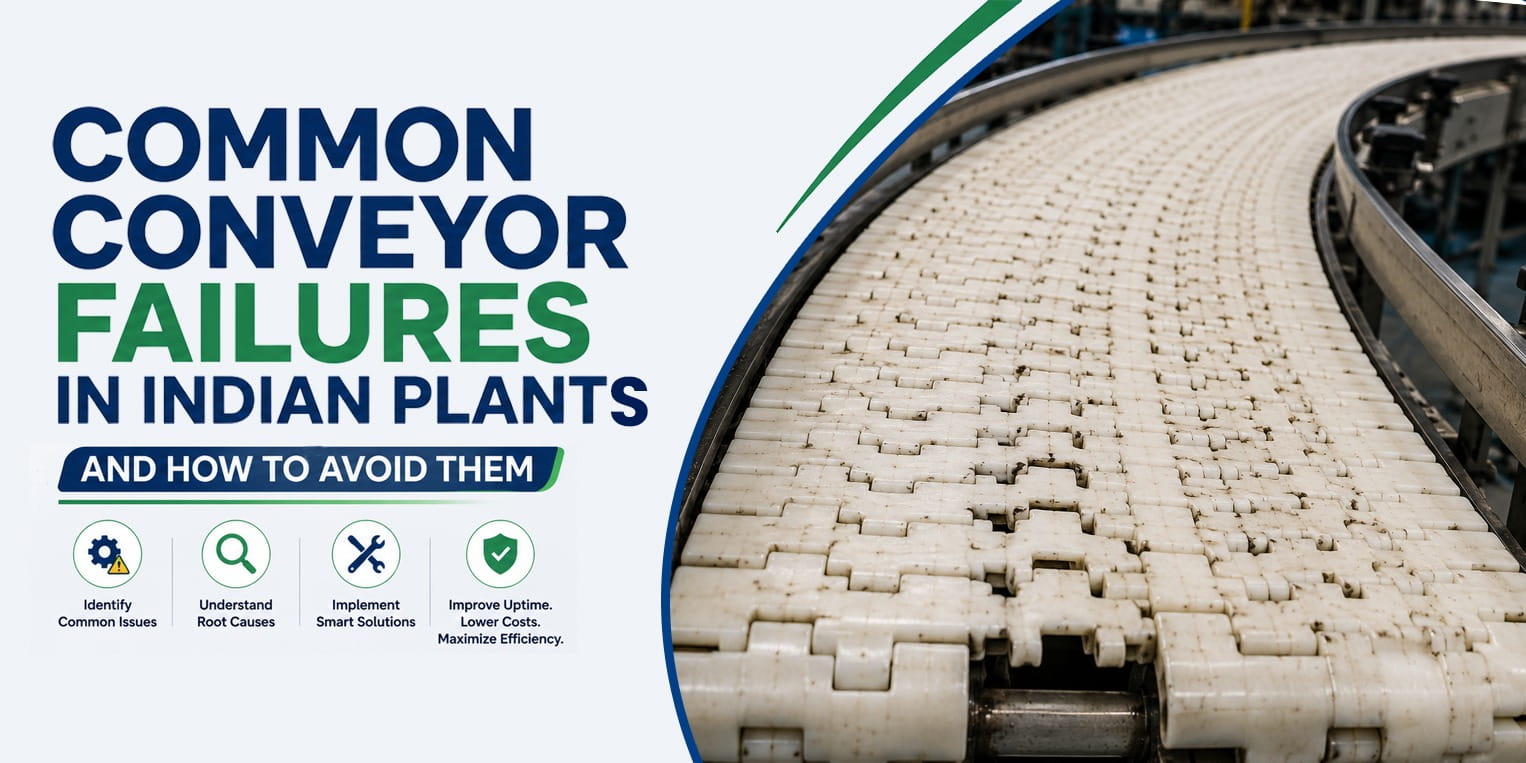
In Indian manufacturing environments – whether in food processing, beverages, FMCG, or packaging – conveyors are not just a utility. They are the backbone of continuous production.
Yet, conveyor failures remain one of the most common causes of unplanned downtime across plants. The issue isn’t just equipment – it’s often a combination of operating conditions, maintenance gaps, and incorrect system design.
This article breaks down the most common conveyor failure causes in Indian plants and, more importantly, how to avoid them through smarter engineering and preventive practices.
1. Belt Misalignment: A Small Issue That Escalates Fast
The Problem
Misalignment is one of the most frequent conveyor issues. It leads to uneven wear, edge damage, and eventual belt failure.
In Indian plants, this is often caused by:
- Improper installation
- Uneven loading
- Worn-out support structures
The Impact
- Increased friction and energy consumption
- Premature belt damage
- Production interruptions
How to Avoid It
- Regular alignment checks as part of preventive maintenance
- Use of positively driven systems like plastic modular belts, which eliminate tracking issues
- Proper frame rigidity and support component design
Well-designed modular systems ensure consistent belt movement without relying heavily on manual adjustments.
2. Excessive Wear & Tear Due to Harsh Conditions
The Problem
Indian plants often operate in:
- High temperatures
- Wet or washdown environments
- Dust-heavy conditions
Traditional belt systems struggle under these conditions.
The Impact
- Frequent replacements
- Hygiene risks (especially in food processing)
- Increased maintenance costs
How to Avoid It
- Use application-specific materials (PP, HDPE, Acetal depending on temperature and load)
- Install low-friction wearstrips (UHMWPE) to reduce abrasion
- Opt for belts that are washable, chemical-resistant, and easy to clean
Material selection is not a detail—it’s a long-term cost decision.
3. Chain & Sprocket Failures
The Problem
Mismatch between chains and sprockets, or poor-quality components, leads to:
- Skipping
- Noise
- Breakage
This is especially common in high-speed bottling and packaging lines.
The Impact
- Sudden breakdowns
- Product damage
- Increased downtime
How to Avoid It
- Ensure correct chain-sprocket compatibility
- Use precision-engineered sprockets for better torque transmission
- Regular lubrication and inspection
Systems with positive sprocket engagement significantly reduce slippage and improve reliability.
4. Poor Maintenance Practices
The Problem
Most failures in India are not due to design—but due to reactive maintenance.
Typical issues include:
- Lack of routine inspection
- Delayed component replacement
- Improper lubrication
The Impact
- Unexpected breakdowns
- Reduced equipment lifespan
- Higher long-term costs
How to Avoid It
- Implement preventive maintenance programs
- Schedule:
- Routine inspections
- Belt alignment checks
- Component replacements before failure
A structured maintenance approach can detect issues early and avoid costly downtime
5. Incorrect Conveyor Design for Application
The Problem
Using a “standard conveyor” for all applications is a common mistake.
Examples:
- Using flat belts where modular belts are needed
- Not accounting for incline, product type, or load variation
- Ignoring layout complexity (turns, accumulation, etc.)
The Impact
- Frequent jams
- Product instability
- Reduced throughput
How to Avoid It
- Choose application-specific conveyor systems
- Use:
- Side-flex belts for curves
- Flights and sidewalls for incline conveying
- Modular designs for flexibility
Customization is critical—no two production lines are identical.
6. Hygiene & Cleaning-Related Failures (Food & Beverage Sector)
The Problem
In industries like dairy, beverages, and packaged foods, improper cleaning leads to:
- Contamination risks
- Belt degradation
The Impact
- Compliance issues
- Product recalls
- Increased water usage and cleaning time
How to Avoid It
- Use open-hinge modular belts for easy washdown
- Ensure belts are:
- Easy to dismantle
- Quick to clean
- Reduce cleaning time and water consumption
Efficient belt design directly impacts hygiene and operational efficiency.
The Bigger Picture: From Breakdown to Predictability
Most conveyor failures are not “unexpected”—they are predictable.
The shift Indian plants need is:
👉 From reactive troubleshooting
👉 To proactive system optimization
This includes:
- Better component selection
- Preventive maintenance
- Application-specific design
- Regular system upgrades
Conclusion
Conveyor failures in Indian plants are rarely caused by a single factor. They are the result of design compromises, maintenance gaps, and unsuitable components working together.
The good news?
Every one of these failures is avoidable.
At UCPL, the focus goes beyond supplying conveyor components. The approach is centered on:
- Enhancing system reliability
- Extending conveyor life
- Reducing downtime through engineered solutions
Because in modern manufacturing, efficiency is not just about speed—it’s about consistency.