
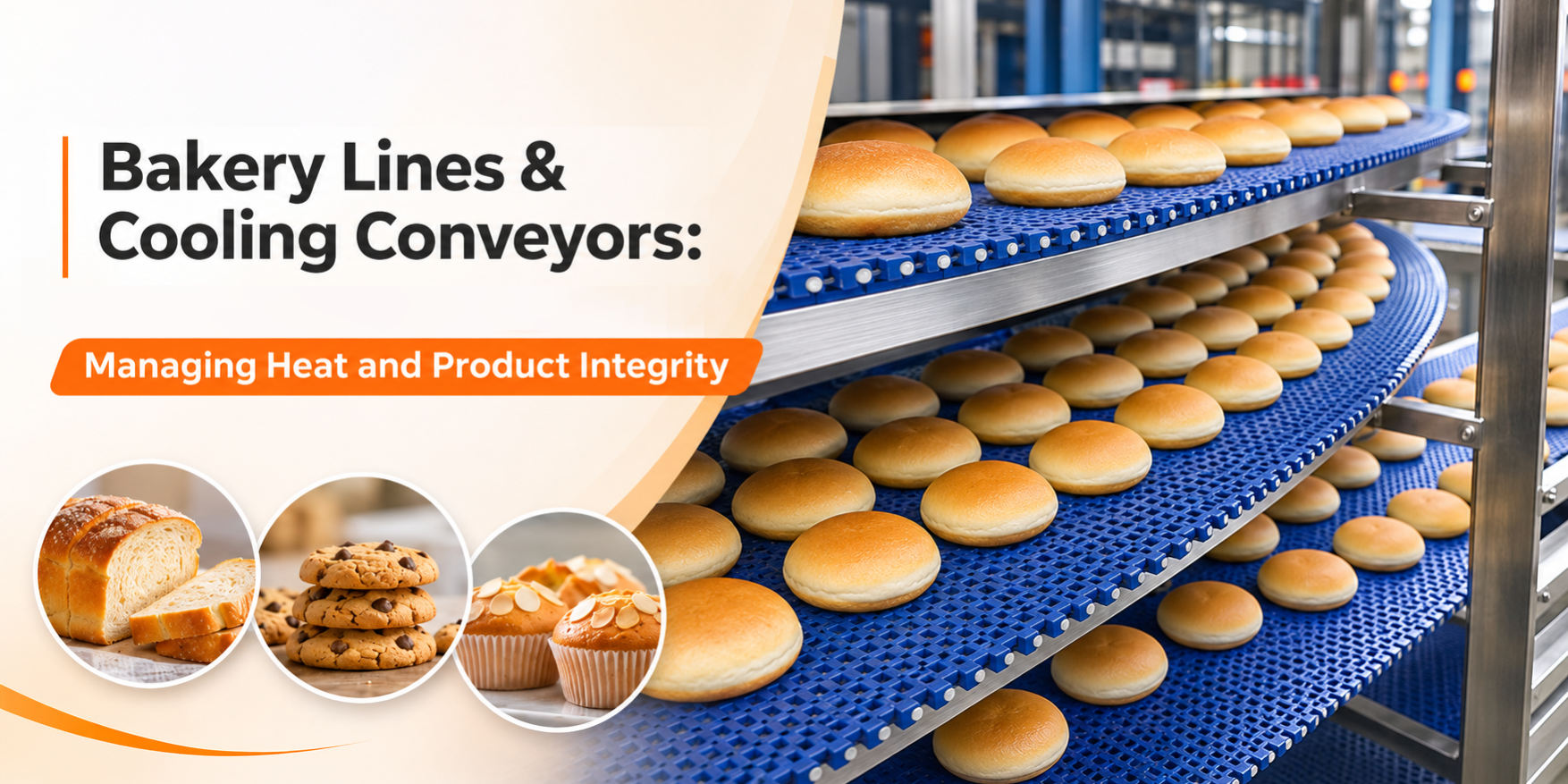
In bakery manufacturing, maintaining product quality goes beyond the baking process. What happens between the oven and the packaging line plays an equally important role in determining the final product’s texture, appearance and consistency.
Freshly baked bread, biscuits, cookies and cakes require controlled cooling and careful handling before they are ready for packaging. Excessive heat, uneven cooling or unsuitable conveyor surfaces can affect product quality and disrupt production flow.
This is where the selection of appropriate bakery conveyor belts and cooling arrangements becomes important.
For bakery manufacturers in India, conveyor systems must do more than transport products. They need to support temperature management, gentle product handling, hygiene and consistent movement across different production stages.
Why Cooling Is Critical in Bakery Production
Products leaving the oven retain heat that needs to be managed before packaging. If products are packed at unsuitable temperatures, condensation may develop inside the packaging, affecting texture, freshness and shelf-life performance.
Different bakery products also respond differently to cooling.
Bread and cakes require careful handling due to their relatively soft structure, while biscuits and cookies may become fragile as they cool. Products containing coatings, fillings or toppings may have additional temperature and handling requirements.
Cooling conveyor systems provide a controlled path for products to move through the cooling stage while allowing sufficient time for heat dissipation.
However, effective cooling depends on several factors working together, including conveyor speed, airflow, ambient temperature, product spacing and the characteristics of the baked product.
A well-planned cooling conveyor arrangement helps manufacturers maintain consistent product movement while supporting the required cooling process.
Key Conveyor Considerations for Bakery Lines
1. Belt Surface and Product Handling
Different bakery products require different levels of support during transportation.
Flat-top modular conveyor belts offer a continuous conveying surface suitable for many product-handling applications. Open-area belt designs, on the other hand, may be considered where airflow or drainage is important.
The selection should account for product size, weight, texture and stability.
For delicate bakery products, the conveyor surface and transfer arrangement must minimise unnecessary movement, impact and product damage.
2. Temperature Compatibility
Temperature is an important consideration when selecting conveyor components for bakery applications.
Conveyors positioned near oven discharge points may experience higher temperatures than those used in downstream cooling or packaging sections.
The belt material must therefore be selected according to actual operating conditions and its specified temperature limits.
Thermoplastic modular belts can be suitable for certain bakery handling and cooling applications, but they should not be assumed suitable for direct exposure to oven temperatures.
Correct material selection helps ensure that conveyor components remain appropriate for the conditions in which they operate.
3. Airflow and Cooling Efficiency
Air circulation influences how effectively heat is removed from freshly baked products.
In suitable applications, open-area modular belts can facilitate airflow around portions of the product, supporting the overall cooling arrangement.
Conveyor speed is equally important. If the belt moves too quickly through a fixed cooling section, products may not receive sufficient cooling time before reaching the packaging stage.
Manufacturers must therefore balance production throughput with the cooling requirements of the product.
4. Smooth Transfers Between Production Stages
Bakery products often move through multiple conveyor sections before reaching packaging equipment.
Each transfer point needs to accommodate the product’s size, shape and handling characteristics.
Incorrect alignment, excessive transfer gaps or unsuitable speed differences can affect product positioning and increase the likelihood of breakage.
Well-planned conveyor transitions help maintain steady movement from baking and cooling to slicing, wrapping or packaging.
5. Hygiene and Cleaning Requirements
Bakery environments involve flour, crumbs, oils and other food residues that can accumulate around conveyor components.
Belt design, material compatibility and accessibility for cleaning are therefore important considerations.
Plastic modular conveyor belts are available in different constructions, including designs that can support cleaning accessibility and drainage in suitable food-processing applications.
The appropriate configuration should be selected according to the facility’s hygiene requirements and cleaning procedures.
Choosing the Right Cooling Conveyor System
When planning a new bakery line or reviewing an existing installation, manufacturers should evaluate the conveyor system in relation to the complete production process.
Some important questions include:
- Product characteristics: Is the product soft, fragile, sticky or sensitive to handling?
- Operating temperature: What temperature will the belt and conveyor components experience?
- Cooling requirements: How much cooling time and airflow does the product need?
- Production capacity: Can the conveyor accommodate the required throughput?
- Cleaning requirements: Is the belt construction suitable for the facility’s hygiene procedures?
- Packaging integration: Will products move smoothly into downstream equipment?
These considerations help manufacturers identify suitable conveyor configurations instead of relying on a standard belt selection for every application.
For businesses searching for bakery conveyor belts in India, understanding these operating requirements is essential to selecting components that support both production efficiency and product quality.
How Ultraplast Chainbelts Supports Bakery Conveyor Applications
At Ultraplast Chainbelts Pvt. Ltd. (UCPL), we understand that conveyor requirements differ across food-processing and packaging environments.
Our product range includes plastic modular belts, thermoplastic slat chains, sprockets, UHMWPE wearstrips, guides and supporting conveyor components for application-specific conveying requirements.
For bakery manufacturers, the selection of appropriate belt surfaces, material grades and conveyor components can contribute to smoother product movement and more reliable operation across suitable handling, cooling and packaging stages.
UCPL works with manufacturers to understand their conveyor applications and identify component options aligned with product characteristics, operating conditions and production requirements.
Conclusion
In bakery manufacturing, product quality must be maintained at every stage, from oven discharge to final packaging.
The right conveyor arrangement supports controlled product movement, appropriate cooling time and gentle handling, while suitable component selection helps maintain consistent operation.
For manufacturers evaluating bakery conveyor belts in India and cooling conveyor systems, the focus should remain on choosing solutions that match the product, process and operating environment.
Because efficient bakery production is not only about how products are baked, but also how they are handled afterwards.
Planning a Bakery Conveyor Line?
Connect with Team Ultraplast Chainbelts Pvt. Ltd. to explore conveyor belts and components suited to your bakery production requirements.