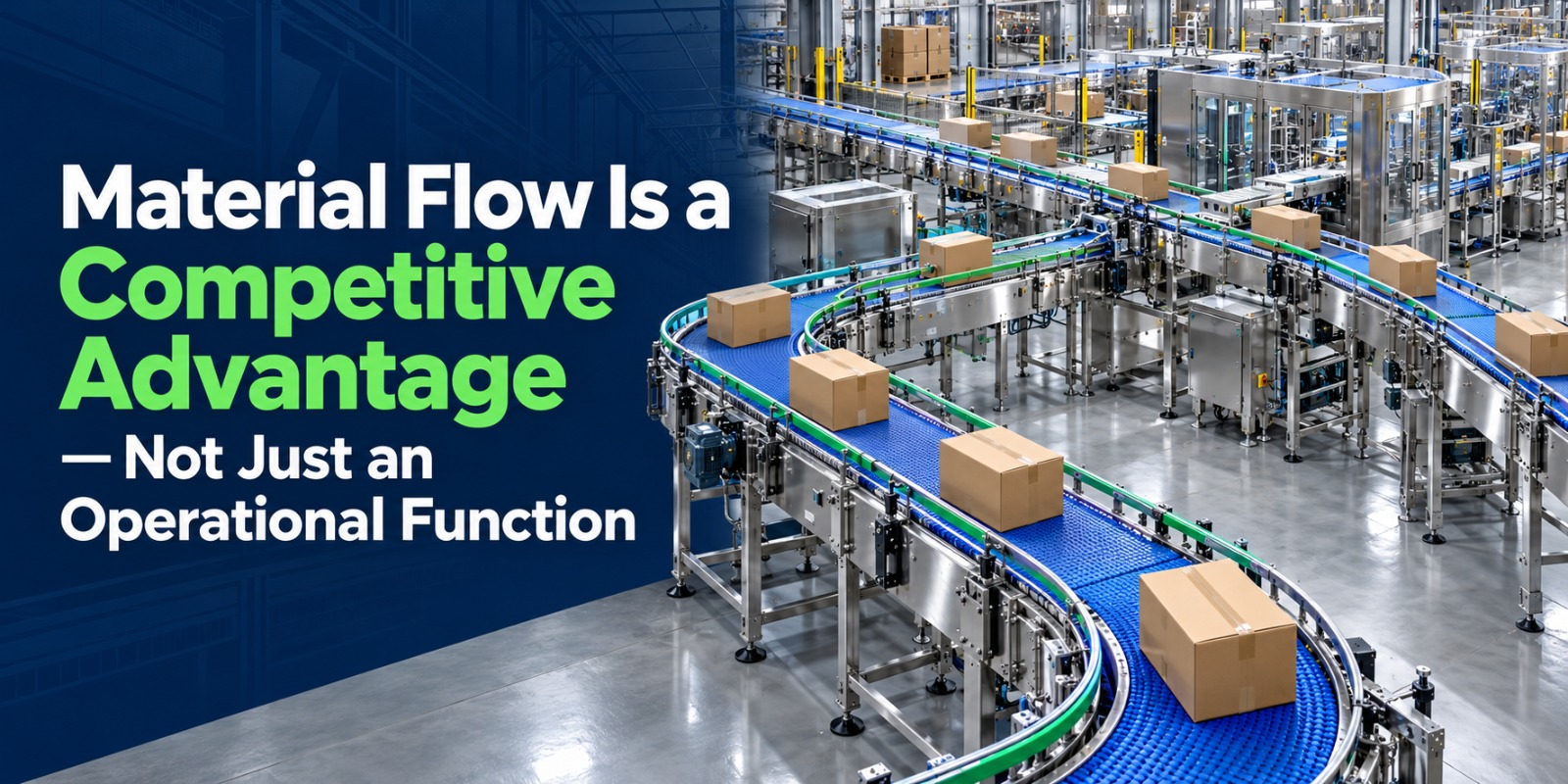
In manufacturing, attention naturally goes to machines, production capacity, cycle times and output. But between every two stages of production, something equally important is happening: material is moving.
Raw materials reach production lines, components move between processes, finished products reach packing and goods eventually move towards storage or dispatch. The efficiency of this movement can influence how smoothly the entire operation performs.
Yet material flow is often treated as a supporting function rather than a strategic consideration.
That is increasingly difficult to overlook.
Efficient material flow can influence productivity, labour utilisation, floor-space efficiency and the ability of a manufacturing operation to scale.
When Movement Becomes Part of Production Efficiency
Material movement does not directly transform a product. But inefficient movement can introduce waiting, unnecessary handling and interruptions into the production process.
A component may need to be manually transferred between workstations. Products may accumulate because two processes operate at different speeds. Material may travel longer distances because of an inefficient plant layout.
Individually, these may appear to be small operational issues. Repeated throughout a high-volume production environment, they can become a significant part of the overall production cycle.
This is where a well-designed material handling system becomes important.
The objective is not simply to move products faster. It is to create a controlled, consistent and predictable flow of material through the manufacturing process.
The Role of Conveyor Systems
Modern conveyor systems are no longer simply about transporting products from one point to another.
Depending on the application, industrial conveyor systems can help connect production stages, manage accumulation, accommodate changes in direction or elevation, reduce repetitive manual handling and make better use of available floor space.
Modular conveyor belts, chains, sprockets, guide rails, wear strips and transfer systems all contribute to how effectively a conveyor performs within a larger material flow.
The right solution therefore starts with understanding the process.
What is being moved?
At what speed?
Between which operations?
What happens if the next process slows down?
How much accumulation is required?
These questions are often more important than simply selecting a conveyor based on load capacity.
Designing for Flow, Not Just Movement
A conveyor can perform its individual function correctly and still be part of an inefficient material flow.
For example, if one production stage operates faster than the next, controlled accumulation may be required. If products change direction, the conveyor needs to maintain their stability and orientation. Where different elevations are involved, an inclined conveyor may eliminate additional manual transfers.
This is why material flow in manufacturing needs to be considered at a system level.
The focus shifts from:
“How do we move this product?”
to:
“How should this product move through the entire process?”
That shift can change the way conveyors, transfers and supporting components are designed.
Efficiency Is Also About People and Space
Better material flow can have benefits beyond production speed.
Reducing repetitive carrying and transferring can allow operators to spend more time on production, inspection and other value-adding activities. At the same time, a planned conveyor layout can reduce unnecessary movement and help organise production areas more effectively.
For industries such as FMCG, food and beverage, dairy, packaging, pharmaceuticals, automotive and logistics, where material may pass through multiple stages and production volumes can be high, these considerations become particularly relevant.
Automation does not necessarily mean redesigning an entire facility. In many cases, improving specific transfer points, accumulation areas or manual handling stages can be a practical step towards better material handling automation.
From Operational Function to Competitive Advantage
Manufacturers are continuously looking for ways to improve throughput, maintain consistency and use resources more effectively.
Material flow sits at the intersection of all three.
A well-planned conveyor system can help production lines maintain their rhythm. The right components can support reliability. Better movement can reduce unnecessary handling. And a more considered layout can help a facility make better use of its available space.
Ultimately, material flow is not what manufactures the product—but it can influence how efficiently the manufacturing system produces it.
That is why conveyor and material handling decisions deserve to be considered not merely as equipment decisions, but as part of the larger strategy for building a more efficient and scalable manufacturing operation.