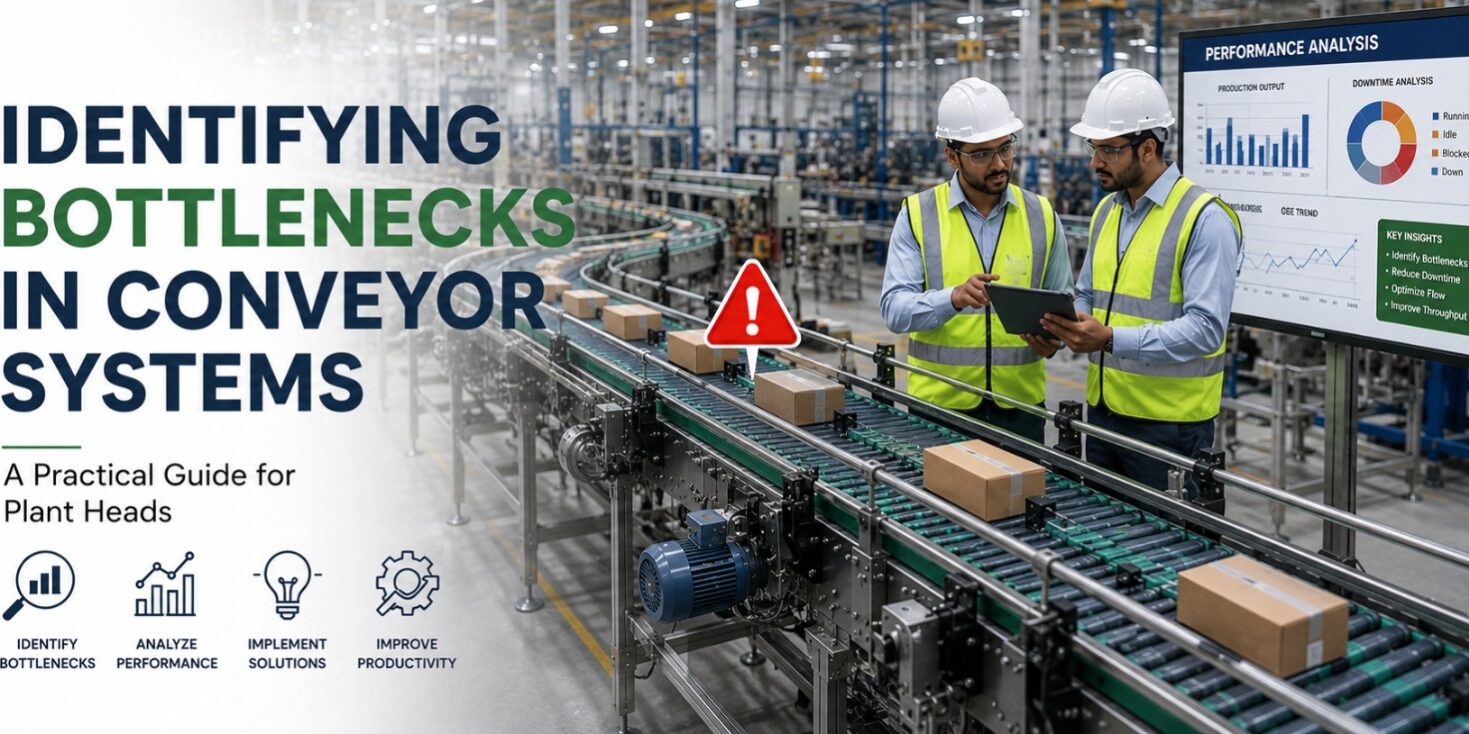
Every Production Delay Has a Starting Point
Production targets are rarely missed because of one major equipment failure.
More often, they are affected by a series of small inefficiencies that gradually slow the entire operation. A few seconds lost during product transfers. Slightly inconsistent line speeds. Frequent operator interventions. Minor stoppages that seem insignificant in isolation.
Over weeks and months, these seemingly minor issues accumulate into reduced throughput, increased operating costs, and lower overall equipment effectiveness (OEE).
One of the most common sources of these hidden losses is the conveyor system.
Because conveyors connect every stage of production, even a small inefficiency at one point can create a ripple effect across the entire manufacturing line. Unfortunately, these bottlenecks often go unnoticed because the conveyor is still moving. The assumption is simple: if the belt or chain is running, the conveyor is performing.
In reality, movement and efficiency are not the same thing.
For Plant Heads responsible for maximizing output while maintaining production stability, identifying conveyor bottlenecks is not just a maintenance activity—it is a strategic opportunity to unlock additional production capacity without expanding the facility.
What Is a Conveyor Bottleneck?
A conveyor bottleneck occurs when one section of the material handling system restricts the smooth flow of products through the production process.
This restriction does not necessarily stop production.
Instead, it creates an imbalance where upstream processes produce faster than downstream operations can handle, or vice versa.
The result may include:
- Product accumulation
- Idle machines waiting for material
- Frequent operator intervention
- Increased cycle times
- Reduced line efficiency
- Higher wear on conveyor components
- Inconsistent production output
In many facilities, these issues develop gradually, making them difficult to identify until productivity has already been affected.
The Cost of Ignoring Small Inefficiencies
Many manufacturers focus on large equipment investments when production targets are missed.
However, conveyor bottlenecks often reduce capacity without requiring major capital expenditure.
Consider a production line operating for two shifts every day.
If a conveyor transfer causes only a five-second delay every cycle, the annual production loss can become substantial. Add repeated product jams, manual realignment, and intermittent stoppages, and the hidden cost becomes even greater.
These inefficiencies may also contribute to:
- Increased labour requirements
- Higher energy consumption
- More frequent equipment wear
- Missed delivery commitments
- Reduced equipment lifespan
- Lower customer satisfaction
The challenge is that these costs rarely appear under a single expense category, making bottlenecks easy to underestimate.
Where Conveyor Bottlenecks Commonly Occur
While every manufacturing process is unique, certain areas consistently become performance constraints.
Transfer Points Between Conveyors
Product transfers are among the most common sources of operational inefficiency.
Poorly designed transfer sections can lead to:
- Product instability
- Misalignment
- Product tipping
- Accumulation
- Increased manual intervention
Even a well-performing conveyor can experience productivity losses if products cannot move smoothly between adjacent systems.
Changes in Conveyor Speed
Production lines often consist of multiple conveyors operating at different speeds.
If speed synchronization is not properly managed, products may begin accumulating in one section while downstream equipment remains underutilized.
Rather than increasing production, the imbalance simply shifts congestion to another point in the process.
Optimizing line speed across interconnected conveyors helps maintain continuous product flow.
Conveyor Curves and Direction Changes
Curved conveyor sections require careful engineering.
Products that travel smoothly on straight sections may behave differently when navigating tighter radii.
Improper guide design or unsuitable conveyor components can lead to:
- Product instability
- Increased friction
- Side pressure
- Component wear
- Reduced conveyor speed
Selecting conveyor solutions designed specifically for curved applications helps maintain consistent flow while minimizing product handling issues.
Accumulation Zones
Modern production frequently requires temporary product accumulation.
However, poorly managed accumulation creates unnecessary pressure on products and conveyor components.
Signs of inefficient accumulation include:
- Product collisions
- Uneven spacing
- Excessive back pressure
- Operator intervention
- Packaging inconsistencies
Proper accumulation design ensures products remain controlled while maintaining steady downstream flow.
Conveyor Component Wear
Not every bottleneck is caused by conveyor layout.
Over time, worn chains, sprockets, wear strips, guide rails, bearings, and drive components gradually reduce conveyor efficiency.
Unlike sudden failures, component wear develops slowly, often causing subtle reductions in production speed long before maintenance teams recognize the issue.
Regular condition assessment allows manufacturers to address these issues proactively rather than waiting for unexpected breakdowns.
Looking Beyond Mechanical Problems
One common misconception is that every conveyor bottleneck is caused by equipment failure.
In reality, bottlenecks frequently result from changes elsewhere in the production process.
For example:
- Increased production volumes
- New product dimensions
- Different packaging formats
- Automation upgrades
- Additional inspection stations
- Modified production sequences
A conveyor system originally designed for one production requirement may no longer support today’s operational demands.
In such cases, improving performance may involve upgrading selected conveyor sections rather than replacing the complete system.
How Plant Heads Can Identify Hidden Constraints
Effective bottleneck analysis begins with observing the production process as a connected system rather than evaluating individual machines independently.
Questions worth asking include:
- Where do products consistently accumulate?
- Which conveyor sections require frequent operator attention?
- Are downstream machines regularly waiting for products?
- Which sections experience the highest maintenance frequency?
- Where do production delays repeatedly occur?
- Have production requirements changed since the conveyor was originally installed?
The answers often reveal opportunities for significant productivity improvements without major infrastructure changes.
Why Data Matters More Than Assumptions
Many production decisions are based on experience, which remains valuable.
However, combining operational knowledge with performance data provides a clearer understanding of conveyor behaviour.
Useful performance indicators include:
- Conveyor utilization
- Downtime frequency
- Line balancing
- Product throughput
- Maintenance history
- Equipment availability
- Overall Equipment Effectiveness (OEE)
When these metrics are reviewed together, bottlenecks become easier to identify and prioritize.
Optimization Doesn't Always Mean Replacement
Plant Heads often assume solving conveyor bottlenecks requires purchasing an entirely new system.
In many situations, targeted improvements deliver significant results with far lower investment.
Depending on the application, optimization may involve:
- Upgrading conveyor chains
- Replacing worn sprockets
- Improving guide rail systems
- Optimizing transfer sections
- Retrofitting accumulation zones
- Redesigning conveyor layouts
- Introducing application-specific conveyor components
These improvements can enhance reliability, improve product flow, and increase overall production efficiency while minimizing disruption to existing operations.
A Continuous Improvement Mindset
The most efficient manufacturing facilities rarely wait for production issues to become critical.
Instead, they regularly evaluate conveyor performance as part of broader operational excellence initiatives.
By treating conveyors as productivity assets rather than simply material transport equipment, manufacturers gain opportunities to:
- Improve throughput
- Reduce downtime
- Lower maintenance costs
- Extend equipment life
- Increase production flexibility
- Support future expansion
Small improvements across multiple conveyor sections often produce measurable gains across the entire production line.
Final Thoughts
Conveyor bottlenecks rarely announce themselves through dramatic failures. More often, they appear as recurring delays, inconsistent product flow, or gradual reductions in line efficiency that become accepted as part of daily operations.
For Plant Heads, recognizing these hidden constraints is an opportunity to improve productivity without necessarily investing in entirely new infrastructure. Careful evaluation of conveyor performance, component condition, transfer efficiency, and overall material flow can reveal practical improvements that enhance operational reliability and support long-term production goals.
At Ultraplast, we work with manufacturers to evaluate conveyor applications, recommend suitable component upgrades, and develop material handling solutions that help production lines operate more efficiently. Whether the requirement is improving an existing conveyor, supporting a line expansion, or optimizing product flow, the focus remains on delivering dependable performance that keeps manufacturing moving.