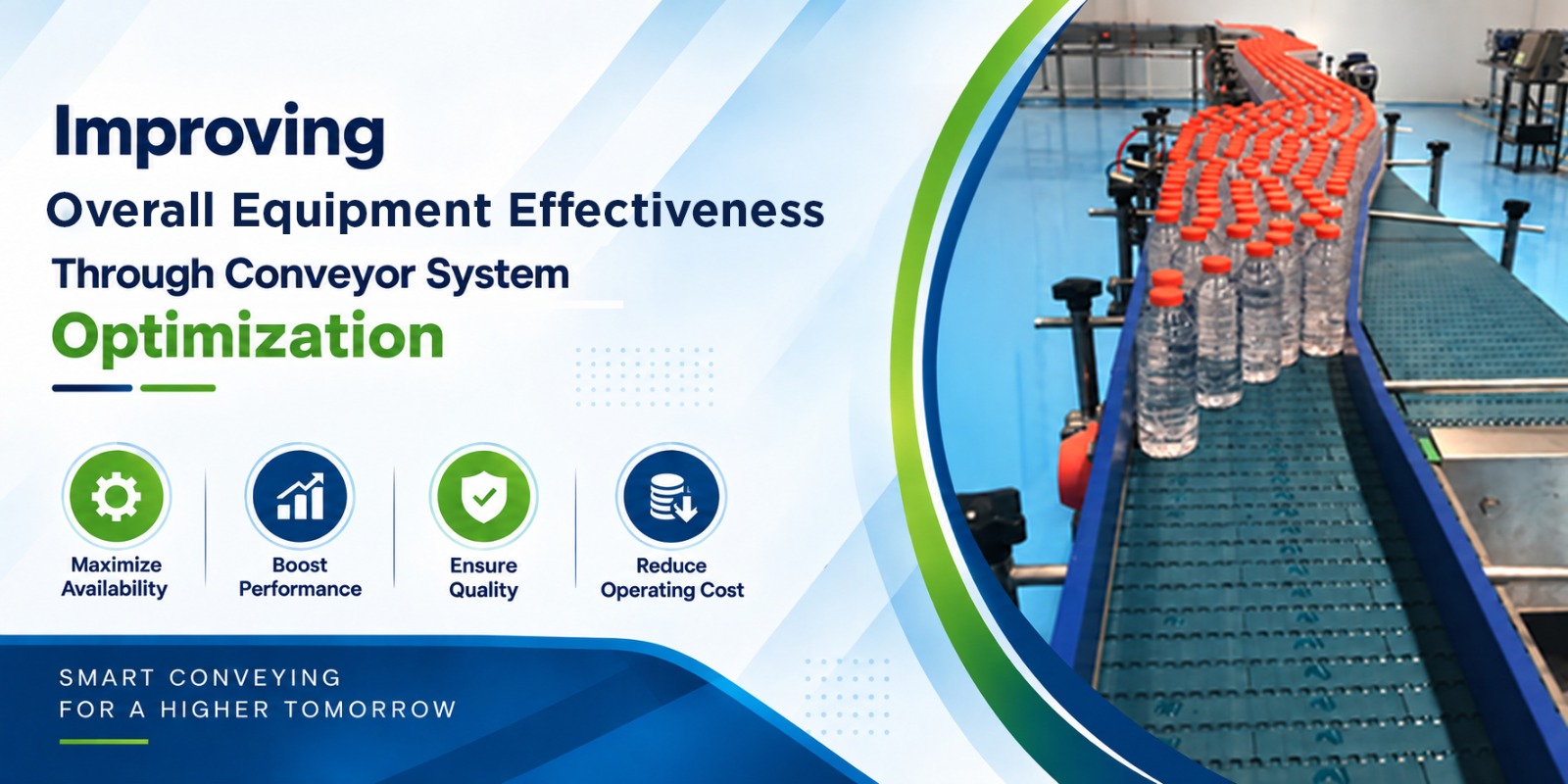
Overall Equipment Effectiveness (OEE) is widely used to evaluate how efficiently a production line is operating. While OEE is often discussed in terms of machines, automation and production equipment, the conveyor system connecting those processes can have an equally important impact on overall performance.
In industries such as food and beverage, FMCG, dairy, packaging and pharmaceuticals, conveyors are responsible for continuously moving products between different stages of production. A conveyor that is poorly configured, incorrectly maintained or operating with unsuitable components can contribute to stoppages, reduced line speed and product handling issues.
This is where conveyor system optimization becomes important.
Optimizing a conveyor system is not simply about increasing belt speed or replacing components. It involves looking at the complete conveying system—from the belt or chain and sprockets to guide rails, wear strips, supports and operating conditions—and ensuring that each component is suited to the application.
Understanding OEE in a Conveyor-Driven Production Line
OEE is generally measured across three key factors:
OEE = Availability × Performance × Quality
Each of these can be influenced by the way a conveyor system is designed and maintained.
1. Availability
Availability measures how much planned production time is actually available for production.
Conveyor-related stoppages can reduce availability through:
- Belt or chain failure
- Sprocket wear or damage
- Misalignment
- Excessive friction
- Worn wear strips
- Guide rail issues
- Unplanned component replacement
- Product jams and accumulation problems
Even a short conveyor stoppage can interrupt multiple processes when the conveyor is part of an interconnected production line.
2. Performance
A conveyor may be operational but still reduce production efficiency if it cannot consistently operate at the required speed.
Excessive friction, poor alignment, unsuitable component selection, inadequate support or improper tension can affect conveyor performance. In high-speed applications, small inefficiencies can become significant when the system operates continuously for long production cycles.
The objective should therefore be to achieve stable conveyor performance at the required operating speed, rather than simply maximizing speed.
3. Quality
Conveyor performance can also influence product quality.
Poor product handling, excessive vibration, uncontrolled accumulation or unsuitable conveying surfaces can lead to product damage, instability or inconsistent movement.
For industries handling sensitive products, packaging or food products, the conveyor system needs to provide controlled movement throughout the process.
Where Conveyor System Optimization Creates an Impact
Improving OEE through conveyor optimization starts with understanding where the system is losing efficiency.
Reduce Unplanned Conveyor Downtime
Unexpected conveyor stoppages are one of the most direct ways to reduce equipment availability.
A preventive maintenance approach should monitor components that experience continuous wear, including:
- Modular belts and slat chains
- Sprockets
- UHMWPE wear strips
- Guide rails
- Bearings and supporting components
- Frame supports and other conveyor accessories
Replacing a component based on condition rather than waiting for failure can help reduce the risk of an unexpected production interruption.
Select Components According to the Application
There is no single conveyor component configuration that works for every production environment.
Factors such as:
- Product type
- Conveyor speed
- Load
- Temperature
- Moisture
- Cleaning procedures
- Accumulation requirements
- Conveyor layout
- Operating hours
can influence component selection.
For example, a conveyor operating in a food-processing environment may have very different requirements from one handling packaged FMCG products.
Selecting the right conveyor belt, chain, sprocket, wear strip and guide rail combination helps ensure that the system is designed around the actual operating conditions.
Improve Conveyor Alignment and Tracking
Alignment issues may initially appear minor, but they can create a chain of problems across the conveyor system.
Poor alignment can increase friction, accelerate wear and affect product movement. Over time, this can result in higher maintenance requirements and unexpected downtime.
Regular inspection of conveyor alignment, sprocket positioning, guide rails and supporting components can help identify these issues before they develop into larger operational problems.
Manage Friction and Wear
Friction is an unavoidable part of conveyor operation, but excessive friction can reduce efficiency and increase component wear.
Wear strips and guide components play an important role in supporting smooth movement. UHMWPE wear strips, for example, are commonly used in conveyor systems where low friction and wear resistance are important considerations.
The objective is not simply to replace worn components but to understand why excessive wear is occurring.
Incorrect material selection, poor alignment, excessive loading or unsuitable operating conditions can all contribute to premature wear.
Optimize Conveyor Speed Without Compromising Reliability
Higher conveyor speed does not automatically translate into higher OEE.
Increasing speed without evaluating the rest of the system can result in:
- Increased wear
- Product instability
- Higher friction
- Accumulation issues
- Greater stress on chains and sprockets
- More frequent maintenance
A better approach is to determine the operating speed that delivers the required production output while maintaining reliable product handling and component performance.
Conveyor optimization is therefore about achieving the right balance between speed, reliability and product handling.
Pay Attention to Accumulation and Product Flow
In many production lines, conveyors do more than transport products from one point to another. They also control the flow between processes.
Poorly managed accumulation can create bottlenecks even when individual machines are capable of higher output.
The conveyor system should therefore be evaluated as part of the complete production line.
Questions worth considering include:
- Where does product accumulation occur?
- Are there unnecessary waiting points?
- Is product spacing consistent?
- Are transfers creating interruptions?
- Can the conveyor maintain the required flow during upstream or downstream variations?
Improving these areas can contribute to better line performance without necessarily requiring major equipment changes.
Preventive Maintenance Is Part of OEE Optimization
Conveyor maintenance should not begin only after a failure occurs.
A structured preventive maintenance program can include regular checks of:
Belts & Chains: Check for wear, damage, elongation and abnormal movement.
Sprockets: Inspect tooth condition, alignment and engagement.
Guide Rails: Check positioning, wear and product guidance.
Wear Strips: Monitor wear patterns and friction-related issues.
Supports & Frames: Check structural stability, alignment and fasteners.
Operating Conditions: Monitor unusual noise, vibration, heat or resistance during operation.
Maintenance teams can also track recurring failures to identify whether a component issue is actually a symptom of a larger system problem.
Think Beyond Individual Components
One of the most important principles of conveyor system optimization is to avoid evaluating components in isolation.
A belt or chain may perform well individually but still experience premature wear if the sprockets are incorrectly aligned. Similarly, replacing a wear strip may not solve a recurring friction problem if the underlying conveyor alignment has not been addressed.
A conveyor system works as an interconnected mechanical system.
Belts, chains, sprockets, wear strips, guide rails and supporting components need to work together.
This systems approach is particularly important in high-throughput manufacturing environments where even small inefficiencies can accumulate over long production cycles.
Using Conveyor Optimization to Improve OEE
A practical approach to improving OEE through conveyor system optimization can be built around five steps:
1. Identify the losses
Use downtime and maintenance records to determine where conveyor-related losses are occurring.
2. Analyse the cause
Determine whether the issue is related to component wear, alignment, loading, speed, product flow or operating conditions.
3. Review component selection
Check whether the existing belts, chains, sprockets, wear strips and guide components are appropriate for the application.
4. Implement preventive measures
Introduce inspection intervals and component replacement criteria based on operating conditions and observed wear.
5. Measure the improvement
Track changes in downtime, maintenance frequency, operating speed and production output to determine whether the optimization has improved actual OEE.
The Role of the Right Conveyor Components
For production environments where conveyors operate continuously, component selection becomes an important part of equipment reliability.
Ultraplast Chainbelts provides conveyor components including plastic modular belts, slat chains, UHMWPE wear strips, guide rails and sprockets for applications across industries such as food and beverage, dairy, FMCG, packaging and pharmaceuticals.
The objective is not simply to replace a failed component. It is to understand the application, operating conditions and system requirements so that the conveyor can deliver consistent performance over its operating life.
Conclusion
Improving OEE is rarely about one machine or one component. It is about reducing the small and recurring losses that prevent a production line from operating at its full potential.
Conveyor systems are an important part of this equation.
By optimizing component selection, reducing unnecessary friction, improving alignment, managing product flow and adopting preventive maintenance practices, manufacturers can work towards higher conveyor reliability, reduced downtime and more consistent production performance.
Ultimately, effective conveyor system optimization is not about running faster at any cost. It is about creating a conveyor system that can run consistently, handle products reliably and support the production rate the line is designed to achieve.