
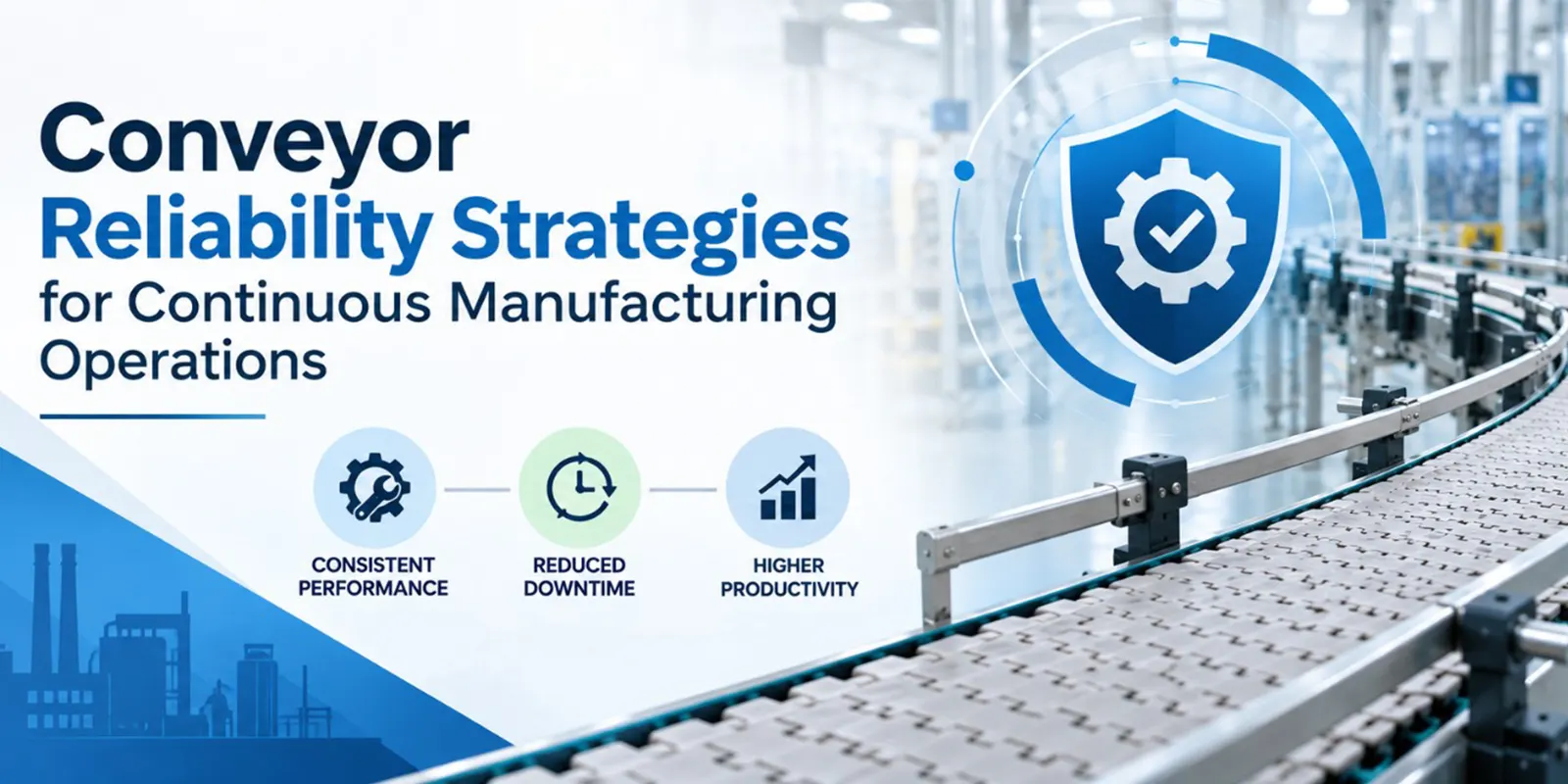
In a single-shift manufacturing environment, a conveyor system may have sufficient downtime for routine inspection, cleaning and maintenance. In a multi-shift manufacturing facility, that window becomes considerably smaller.
When conveyors operate for 16, 20 or even 24 hours a day, five or seven days a week, the design priorities change. Component life, maintenance accessibility, friction, product handling, alignment and wear become critical to maintaining consistent production.
For industries such as food and beverage, dairy, FMCG, packaging and pharmaceuticals, where conveyor systems are integral to material movement and production flow, designing for multi-shift operation means planning for the entire operating lifecycle—not simply the initial installation.
A well-designed conveyor system should be capable of handling sustained operation while making maintenance predictable, component replacement manageable and production interruptions minimal.
Why Multi-Shift Manufacturing Requires a Different Conveyor Approach
Conveyor systems in multi-shift plants are exposed to significantly more operating hours than those used intermittently.
This increases the importance of:
- Continuous and reliable product movement
- Component wear management
- Thermal and mechanical loading
- Proper alignment
- Friction control
- Preventive maintenance
- Easy access to serviceable components
- Consistent performance across operating shifts
A component that performs adequately under occasional operation may experience significantly more wear when subjected to continuous production cycles.
This is why conveyor system design for multi-shift manufacturing needs to account for operating hours, load conditions and maintenance requirements from the beginning.
1. Start With the Actual Operating Conditions
Conveyor design should begin with the application rather than the component.
Before selecting belts, chains or other conveyor components, manufacturers should evaluate:
- Number of operating shifts
- Daily operating hours
- Production rate
- Product weight and dimensions
- Conveyor speed
- Accumulation requirements
- Ambient temperature
- Moisture and cleaning conditions
- Frequency of starts and stops
- Required maintenance windows
These factors directly influence component selection and conveyor configuration.
For example, a conveyor operating continuously in a packaging line will have different requirements from one used for intermittent material transfer.
Understanding these conditions early helps prevent a common problem: selecting components based only on initial performance rather than long-term operating requirements.
2. Select Conveyor Components for Extended Operating Hours
In multi-shift manufacturing, component durability becomes particularly important because wear accumulates with operating time.
The conveyor system may include:
- Plastic modular belts
- Slat chains
- Sprockets
- UHMWPE wear strips
- Guide rails
- Supporting components
Each component contributes to the overall performance of the conveyor.
The selection should consider not only load capacity but also friction, wear characteristics, speed, environmental conditions and compatibility with the rest of the system.
The objective is to build a component combination that can perform consistently over extended operating cycles.
3. Pay Close Attention to Wear Components
Wear components can have a disproportionate effect on conveyor performance.
Wear strips and guide components are continuously exposed to movement and friction. As operating hours increase, inadequate material selection or poor alignment can accelerate wear.
UHMWPE wear strips are widely used in conveyor applications where low friction and wear resistance are important considerations.
However, material selection alone does not eliminate wear. The system should also be evaluated for alignment, loading, surface contact and operating conditions.
For multi-shift plants, establishing inspection and replacement criteria for wear components can help prevent small wear issues from becoming unplanned production stoppages.
4. Consider the Complete Belt-and-Sprocket System
A conveyor belt or chain does not operate independently.
Its performance depends on its interaction with sprockets, wear strips, guide components and the conveyor structure.
Incorrect sprocket alignment, worn teeth or unsuitable engagement can contribute to irregular movement and accelerated wear.
During conveyor design, the complete drive and conveying arrangement should therefore be evaluated rather than treating the belt or chain as an isolated component.
This becomes particularly important when the conveyor is expected to operate continuously across multiple shifts.
5. Design for Controlled Product Flow
Multi-shift production places considerable importance on consistent product flow.
A conveyor may remain mechanically operational but still create production losses if products are not transferred, accumulated or spaced correctly.
Poor product flow can lead to:
- Product congestion
- Unnecessary accumulation
- Irregular spacing
- Transfer problems
- Downstream interruptions
- Reduced line speed
Conveyor design should therefore consider how products behave throughout the complete conveying route.
The objective is not simply to move products from Point A to Point B, but to maintain a predictable flow between production, inspection, packaging and dispatch stages.
6. Account for Starts, Stops and Accumulation
Multi-shift systems are not necessarily running at one constant speed throughout the day.
Conveyors may experience frequent starts and stops due to upstream or downstream equipment, product accumulation, changeovers or production variations.
These operating cycles place different demands on conveyor components compared with continuous steady-state operation.
The conveyor design should therefore consider:
- Starting loads
- Acceleration and deceleration
- Accumulation pressure
- Product spacing
- Transfer points
- Drive requirements
A system designed around only the nominal running speed may not adequately account for these operating conditions.
7. Make Maintenance Part of the Conveyor Design
In a multi-shift facility, maintenance cannot always be treated as a separate activity.
The conveyor itself should be designed to make inspection and servicing as practical as possible.
Maintenance teams should have access to components that require periodic inspection or replacement, including:
- Belts and chains
- Sprockets
- Wear strips
- Guide rails
- Bearings and supporting components
Where maintenance access is difficult, even a simple component replacement can consume valuable production time.
Designing for maintainability can therefore be just as important as designing for performance.
8. Reduce Friction to Improve Long-Term Performance
Friction affects energy consumption, component wear and overall conveyor performance.
In a multi-shift operation, even small amounts of unnecessary friction can accumulate over thousands of operating hours.
The causes may include:
- Incorrect wear-strip selection
- Misalignment
- Excessive loading
- Improper component engagement
- Inadequate lubrication where applicable
- Surface contamination
Reducing unnecessary friction should therefore be considered during both conveyor design and maintenance planning.
The goal is not merely lower resistance but a conveying system that maintains predictable movement over extended operating periods.
9. Design Around the Maintenance Window
One of the practical challenges of multi-shift manufacturing is limited maintenance time.
Production may have only a short window between shifts, during planned changeovers or during scheduled shutdowns.
This makes component life and maintenance intervals important design considerations.
A conveyor system designed with easily inspectable and replaceable wear components can help maintenance teams work within these limited windows.
Preventive maintenance can then be scheduled around production rather than being triggered by unexpected component failure.
10. Consider Hygiene and Cleaning Requirements
For food, beverage, dairy and pharmaceutical applications, conveyor design must also account for cleaning and hygiene requirements.
The operating environment may involve:
- Regular washdown
- Moisture
- Cleaning chemicals
- Temperature variations
- Product residues
Components should therefore be selected according to the actual environmental conditions in which they will operate.
A conveyor designed for dry packaging conditions may require a different component strategy when exposed to frequent washdown or moisture.
This is another reason why conveyor component selection should be application-specific.
11. Standardization Can Simplify Multi-Shift Maintenance
Where practical, standardizing commonly used conveyor components across a facility can simplify maintenance.
If multiple conveyor lines use compatible or standardized components, maintenance teams may benefit from:
- Easier spare-parts planning
- Simplified inventory management
- Faster component identification
- Reduced training requirements
- Quicker maintenance response
Standardization does not mean using the same component everywhere. The application still determines the technical requirement.
Instead, it means identifying opportunities to reduce unnecessary variation while maintaining the required conveyor performance.
12. Monitor Component Condition Over Time
Multi-shift conveyor design should also consider how component condition will be monitored.
Maintenance teams can track indicators such as:
- Wear patterns
- Unusual noise
- Increased friction
- Belt or chain movement
- Sprocket condition
- Product handling issues
- Increasing maintenance frequency
These observations can provide useful information about the actual operating condition of the conveyor.
Over time, maintenance data can also help determine whether a component needs to be redesigned, replaced with a different material or included in a shorter inspection cycle.
Designing for Reliability, Not Just Capacity
A conveyor designed for multi-shift manufacturing should not be evaluated only on its maximum load or rated speed.
Its real value lies in how consistently it performs over extended operating hours.
A reliable conveyor system should combine:
Correct component selection + appropriate system design + controlled product flow + effective maintenance access + predictable wear management
When these factors are considered together, manufacturers can reduce the likelihood of avoidable interruptions and create a conveyor system better suited to demanding production schedules.
The Role of Conveyor Components in Multi-Shift Operations
For multi-shift manufacturing, the individual components of a conveyor system become part of a larger reliability strategy.
Plastic modular belts and slat chains provide the conveying surface, while sprockets support positive engagement. Guide rails help control product movement, and UHMWPE wear strips can help manage friction and wear between moving and supporting surfaces.
The performance of the system ultimately depends on how these components work together under actual operating conditions.
At Ultraplast Chainbelts, conveyor components are supplied for demanding applications across industries including food and beverage, dairy, FMCG, packaging and pharmaceuticals.
Understanding the operating environment, production requirements and maintenance conditions is essential when selecting components for a multi-shift conveyor application.
Conclusion
Multi-shift manufacturing changes the way conveyor systems need to be designed.
With longer operating hours and limited maintenance windows, manufacturers need to think beyond initial installation and consider component life, friction, alignment, product flow, maintainability and environmental conditions.
The most effective conveyor systems are not necessarily those with the highest speed or capacity. They are the systems designed around the realities of production—and capable of delivering consistent performance shift after shift.
For manufacturers, investing thought into conveyor design at the beginning can help reduce avoidable maintenance interruptions later, supporting a more reliable and efficient production line over its operating life.