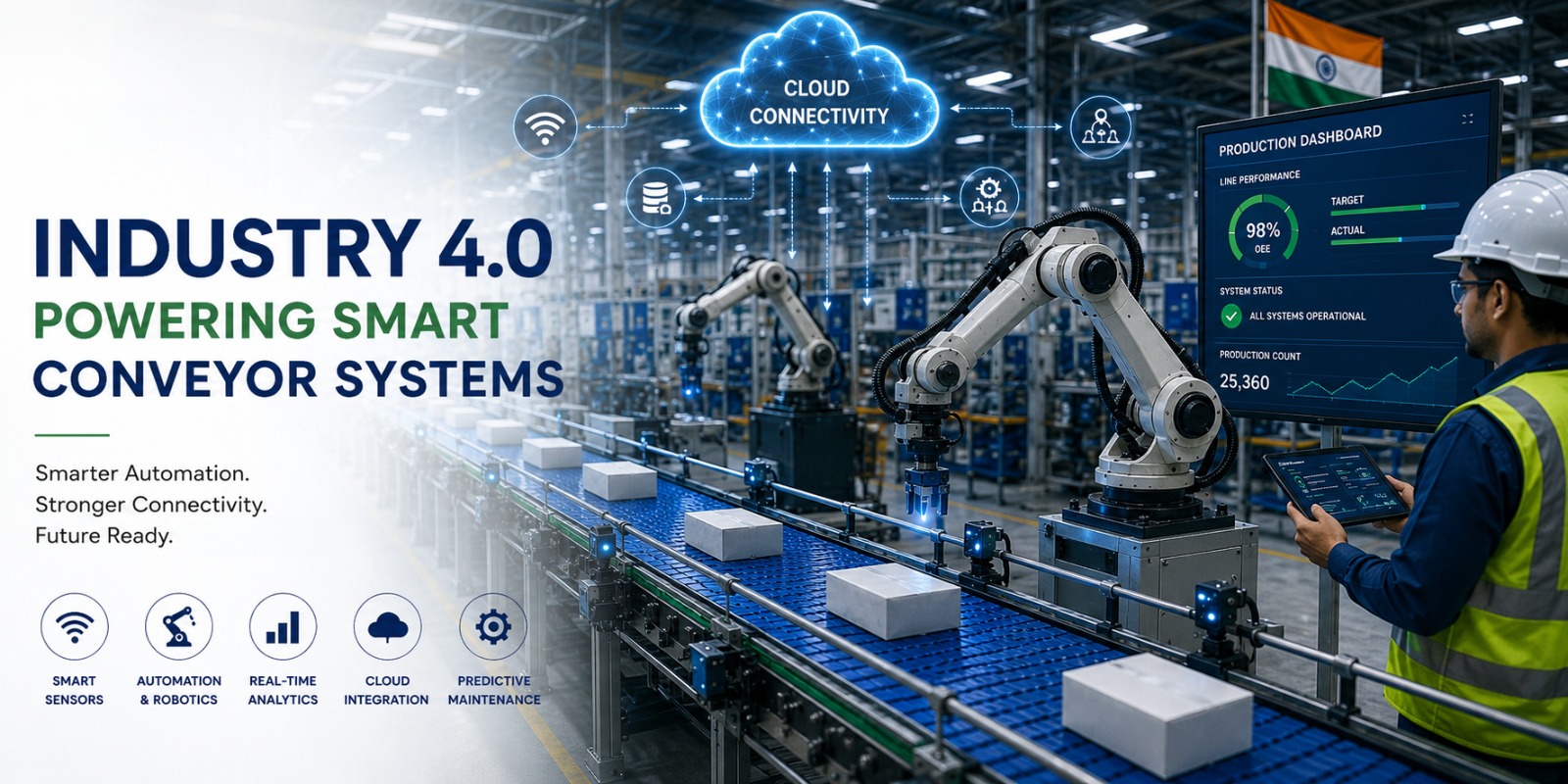
The conversation around Industry 4.0 in India has moved beyond buzzwords. Automation, data, and smart manufacturing are no longer optional—they are becoming essential for competitiveness.
Yet, when we look at actual plant floors, there’s a gap.
Machines may be automated. Software may be upgraded.
But one critical system often remains overlooked:
👉 Conveyors
The backbone of material movement is still largely operating in a pre-digital, reactive mode.
So the real question is not whether Industry 4.0 is coming to India—
It’s whether Indian conveyor systems are ready for it.
What Does Industry 4.0 Mean for Conveyors?
Traditionally, conveyors have been:
- Mechanical systems
- Operated with minimal monitoring
- Maintained reactively
Industry 4.0 transforms this into:
👉 Connected, intelligent, and self-aware conveyor systems
This includes:
- Real-time performance monitoring
- Predictive maintenance
- Data-driven decision-making
- Integration with plant-wide automation systems
In short, conveyors move from being passive equipment to active data contributors.
The Current Reality in Indian Plants
Most Indian manufacturing plants fall into three categories:
1. Fully Traditional
- Manual monitoring
- Breakdown-based maintenance
- Limited automation
2. Partially Automated
- PLC-driven systems
- Some level of process control
- Limited data integration
3. Digitally Evolving
- Sensor-based monitoring
- Data tracking for performance
- Integration with ERP/MES systems
While the shift has begun, conveyor systems are often the last to be upgraded.
Why Conveyors Are Critical in Industry 4.0
Ignoring conveyors in digital transformation creates a blind spot.
Because conveyors directly impact:
- Production flow
- Line efficiency
- Bottlenecks
- Downtime
If conveyors are not monitored:
👉 The entire “smart factory” loses visibility.
Key Industry 4.0 Capabilities for Conveyor Systems
1. Real-Time Monitoring
Sensors can track:
- Speed
- Load
- Vibration
- Temperature
This helps identify anomalies before they turn into failures.
2. Predictive Maintenance
Instead of reacting to breakdowns, plants can:
- Predict component wear
- Schedule maintenance in advance
- Reduce unexpected downtime
This is a major shift from traditional practices in India.
3. Data-Driven Optimization
With data insights, plants can:
- Identify bottlenecks
- Optimize conveyor speed
- Improve throughput
Conveyors become a performance optimization tool, not just a transport system.
4. Integration with Automation Systems
Smart conveyors can integrate with:
- PLCs
- SCADA systems
- MES platforms
This ensures seamless coordination across the production line.
Challenges Indian Plants Face in Adopting Industry 4.0 Conveyors
1. Legacy Infrastructure
Many plants operate on:
- Older conveyor systems
- Outdated components
- Limited upgrade flexibility
Retrofitting becomes a challenge.
2. Cost Perception
There is often a belief that:
👉 “Smart systems are expensive”
However, the real cost lies in:
- Downtime
- Inefficiency
- Frequent repairs
3. Skill Gap
Industry 4.0 requires:
- Data interpretation
- System integration expertise
- Maintenance team training
This is still evolving in many plants.
4. Lack of Awareness at System Level
Digital transformation often focuses on:
- Machines
- Robotics
- Software
But ignores:
👉 Material handling systems like conveyors
The Role of Modern Conveyor Design in Industry 4.0
Before adding sensors and data layers, the foundation must be strong.
Modern conveyor systems are designed for:
- Reliability
- Low maintenance
- Consistent performance
For example:
- Modular belts offer predictable operation and easy repair
- Thermoplastic chains provide smooth, low-noise conveying
- Low-friction components reduce wear and energy consumption
These design improvements ensure that:
👉 The data collected is meaningful and consistent
Because a poorly designed system cannot be “fixed” with technology alone.
Retrofitting vs New Installation: What Should Plants Do?
Retrofitting Existing Systems
Ideal when:
- Core structure is strong
- Only monitoring and control need upgrading
Add:
- Sensors
- Monitoring tools
- Basic automation layers
New System Installation
Recommended when:
- Frequent failures occur
- Maintenance costs are high
- System design is outdated
A new system can be built with:
- Industry 4.0 compatibility
- Scalable architecture
- Integrated monitoring
The Way Forward for Indian Plants
The transition doesn’t have to be immediate or expensive.
A phased approach works best:
Step 1: Stabilize the System
- Fix alignment, tracking, and wear issues
- Ensure reliable operation
Step 2: Optimize Components
- Upgrade to low-maintenance, high-performance materials
- Improve efficiency
Step 3: Introduce Monitoring
- Add sensors
- Track key parameters
Step 4: Enable Data Integration
- Connect conveyors with plant systems
- Use insights for decision-making
Are Indian Plants Ready?
Conclusion
Industry 4.0 is not just about automation—it’s about visibility, predictability, and control.
And conveyors play a central role in all three.
For Indian plants, the opportunity is clear:
- Upgrade from reactive systems
- Invest in reliable conveyor design
- Gradually integrate digital capabilities
At UCPL, the focus is on enabling this transition—not just through advanced components, but through systems that are built for consistency, scalability, and future readiness.
Because in a smart factory,
every movement matters—and every conveyor tells a story through data.