
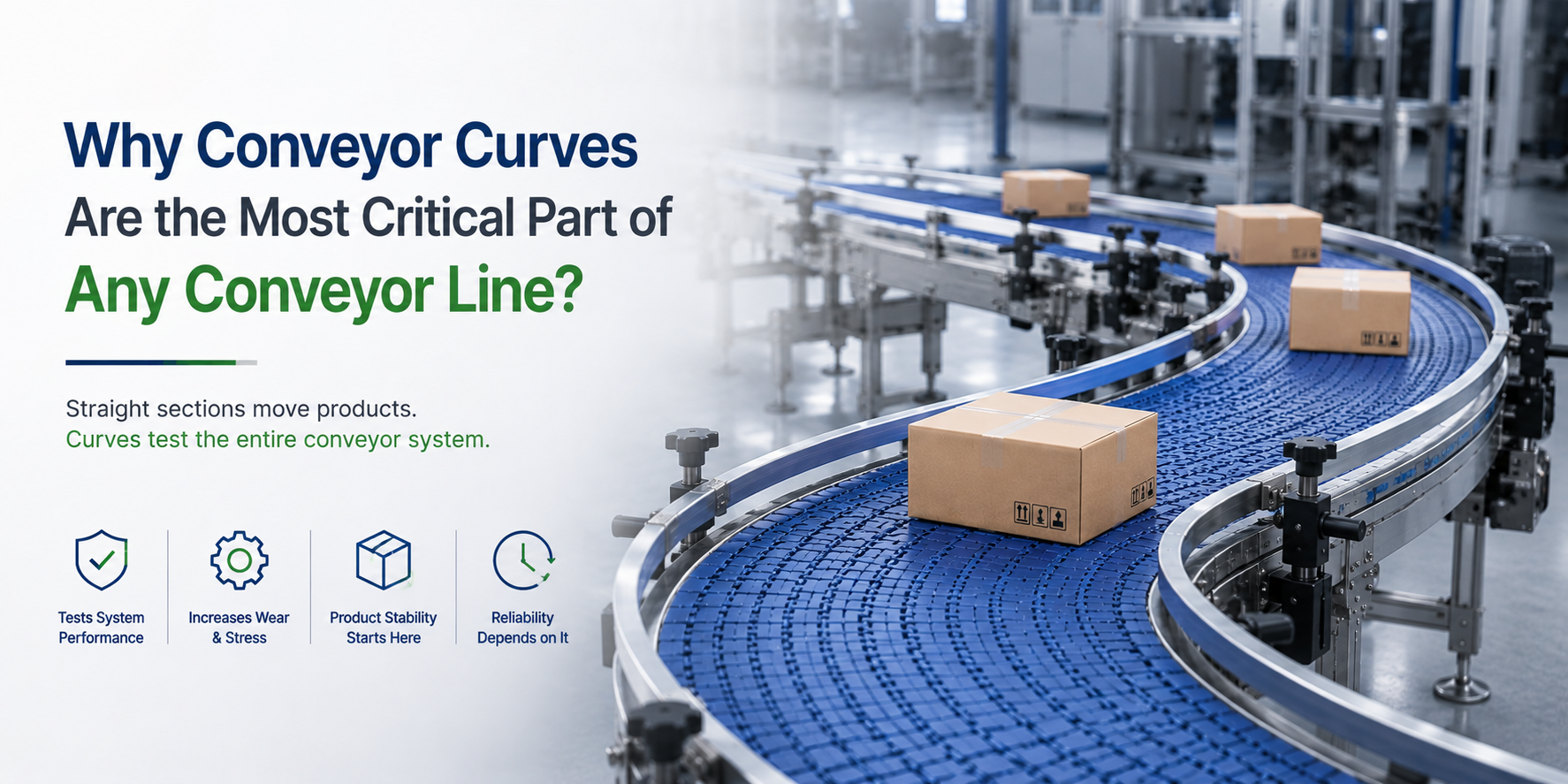
Straight sections move products. Curves test the entire conveyor system.
When manufacturers experience frequent conveyor issues—product tipping, chain wear, increased noise, or unexpected downtime—the root cause is often not found on the straight sections of the conveyor. More often than not, it begins at the curves.
Whether in food processing, beverage bottling, pharmaceuticals, FMCG, or packaging, conveyor curves are the most demanding sections of any material handling system. They introduce directional changes, varying loads, increased friction, and complex mechanical forces that can quickly expose weaknesses in conveyor design or component selection.
Understanding why curves are so critical can help manufacturers improve reliability, reduce maintenance costs, and extend the life of their conveyor systems.
Why Conveyor Curves Are Different
On a straight conveyor, products move in a predictable linear path with relatively uniform loading. Curved sections, however, require products and conveyor components to change direction while maintaining consistent speed and alignment.
During this transition, every conveyor component—from chains and sprockets to guide rails and wear strips—is subjected to greater stress.
Common challenges at conveyor curves include:
- Increased chain tension
- Higher friction between moving parts
- Product instability or tipping
- Uneven component wear
- Noise and vibration
- Reduced conveyor efficiency
Even if the rest of the conveyor system performs flawlessly, poorly designed curves can become recurring maintenance hotspots.
The Hidden Cost of Poorly Designed Curves
Many production teams initially notice only the visible symptoms:
- Products falling during turns
- Conveyor jams
- Excessive chain replacement
- Frequent maintenance shutdowns
However, the long-term impact extends much further.
Poorly engineered curves often result in:
- Higher operating costs
- Increased energy consumption
- Premature wear of conveyor components
- Lower Overall Equipment Effectiveness (OEE)
- Reduced production throughput
- Unplanned downtime affecting entire production lines
What appears to be a minor mechanical issue can gradually become a significant operational expense.
Why Component Selection Matters
Successful conveyor curves are not achieved by a single component—they are the result of a system where every element works together seamlessly.
Side-Flexing Chains
Curves require chains specifically designed to negotiate directional changes without excessive resistance.
High-quality side-flexing chains maintain smooth movement, reduce stress on the drive system, and improve product stability throughout the curve.
UHMWPE Wear Strips
Wear strips guide the chain while minimizing friction between moving components.
Premium UHMWPE wear strips offer:
- Low coefficient of friction
- Reduced chain wear
- Lower maintenance requirements
- Quieter conveyor operation
Longer service life
Precision Guide Rails
Guide rails become particularly important during curves, where products naturally tend to drift outward due to centrifugal forces.
Properly aligned guide rails help:
- Maintain product orientation
- Prevent tipping
- Reduce collisions
Ensure smooth product flow
Sprockets Designed for Accurate Engagement
I am text block. Click edit button to change this text. Lorem ipsum dolor sit amet, consectetur adipiscing elit. Ut elit tellus, luctus nec ullamcorper mattis, pulvinar dapibus leo.
Curves Demand Better Engineering—Not Slower Speeds
A common response to instability at conveyor curves is to reduce conveyor speed.
While slowing the line may temporarily reduce visible issues, it rarely addresses the underlying cause.
In many cases, instability results from:
- Incorrect chain selection
- Worn wear strips
- Poor guide rail alignment
- Incompatible sprockets
- Improper curve geometry
Addressing these factors allows manufacturers to maintain production speed while improving reliability.
Warning Signs Your Conveyor Curves Need Attention
Early identification can prevent costly breakdowns.
Watch for:
- Products leaning or tipping during turns
- Excessive chain noise around curves
- Uneven wear on chains or wear strips
- Frequent lubrication requirements
- Product accumulation before or after curves
- Increased motor load
- Visible vibration during operation
Ignoring these signs often leads to larger maintenance issues over time.
Building Reliable Conveyor Curves
Reliable conveyor curves are achieved through careful planning rather than reactive maintenance.
Key considerations include:
- Selecting the appropriate side-flexing chain
- Using application-specific modular belts where required
- Installing high-quality UHMWPE wear strips
- Ensuring precise guide rail alignment
- Matching sprockets to chain specifications
- Maintaining correct chain tension
- Conducting regular inspections of high-wear areas
These seemingly small engineering decisions have a significant impact on conveyor performance and lifecycle costs.
Why the Right Partner Makes the Difference
Every production environment presents unique challenges. A beverage bottling line operates differently from a pharmaceutical packaging facility or an FMCG distribution centre.
Choosing conveyor components based solely on price often results in increased maintenance costs and shorter equipment life.
Working with an experienced conveyor component partner ensures that every element—from chains and sprockets to guide rails and wear strips—is selected to suit the specific application, operating conditions, and production objectives.
Conclusion
Conveyor curves may occupy only a small portion of the production line, but they have a disproportionate influence on overall system performance.
When curves are engineered with the right components and maintained correctly, manufacturers benefit from smoother product handling, reduced downtime, longer component life, and higher operational efficiency.
At Ultraplast Chainbelts Pvt. Ltd. (UCPL), we understand that reliable conveyor performance begins with dependable components. Our range of plastic modular belts, slat chains, UHMWPE wear strips, guide rails, and sprockets is engineered to deliver consistent performance—even in the most demanding conveyor curve applications.