
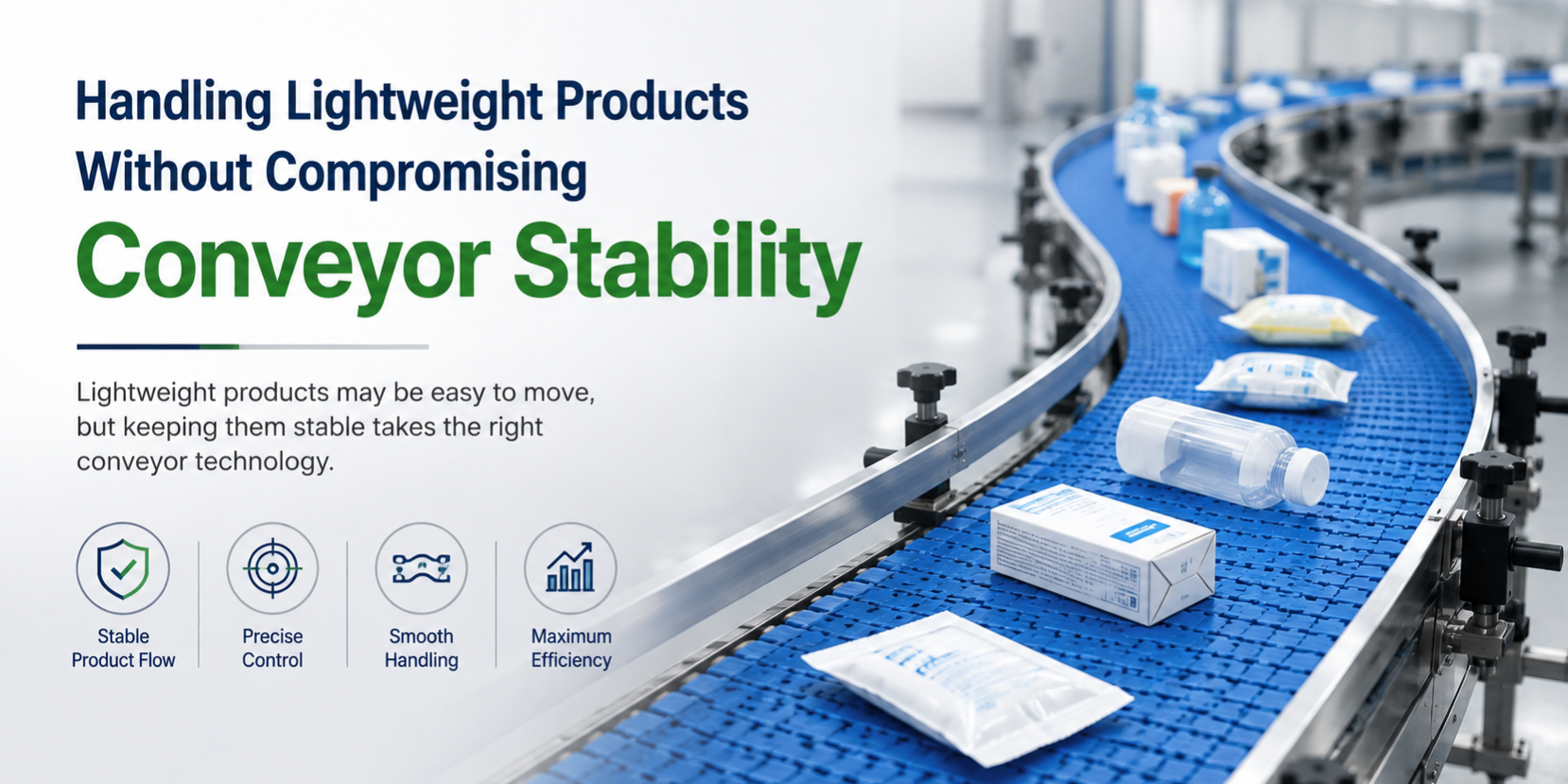
In modern manufacturing, lightweight products are becoming increasingly common across industries such as food processing, beverages, pharmaceuticals, personal care, FMCG, and packaging. Whether it’s empty PET bottles, pouches, cartons, blister packs, or lightweight containers, these products improve logistics and reduce material costs—but they also introduce a unique challenge: maintaining stable product movement throughout the conveyor line.
Unlike heavier products that naturally remain stable during transportation, lightweight items are more susceptible to tipping, shifting, bouncing, or misalignment, especially on high-speed production lines. Even minor instability can lead to product jams, unplanned downtime, damaged goods, and reduced operational efficiency.
The good news is that these challenges can be effectively addressed through proper conveyor design and the right choice of conveyor components.
Why Lightweight Products Behave Differently
The lower the product weight, the more it is influenced by external forces during conveying. Factors such as:
- Sudden acceleration or deceleration
- Conveyor transitions
- Curves and bends
- Uneven belt movement
- Airflow from cooling systems or surrounding equipment
- Product dimensions and centre of gravity
can all affect product stability.
This is why conveyor systems designed for heavier loads may not always perform efficiently when handling lightweight packaging.
The Role of Conveyor Components in Product Stability
Achieving smooth product handling isn’t solely dependent on the conveyor itself—it largely depends on the quality and suitability of its individual components.
1. Stable Modular Belts
Plastic modular belts provide a consistent conveying surface that minimizes vibration and uneven movement. Choosing the appropriate belt design based on product size and weight helps reduce product instability while maintaining smooth transportation.
For lightweight applications, selecting the correct belt pitch, surface texture, and open-area configuration is equally important.
2. Precision Guide Rails
Guide rails play a critical role in preventing lateral movement without restricting product flow.
Properly positioned guide rails:
- Keep products aligned
- Reduce tipping during curves
- Improve line consistency
- Minimize product collisions
Adjustable guide rail systems become particularly valuable when production lines handle multiple product sizes.
3. Low-Friction Wear Strips
High-quality UHMWPE wear strips ensure smoother chain movement while reducing vibration and resistance.
Lower friction translates into:
- Better conveyor stability
- Reduced chain wear
- Lower energy consumption
- Consistent product flow
This becomes increasingly important on long conveyor runs or high-speed packaging lines.
4. Well-Designed Conveyor Curves
Curves are often where lightweight products experience the highest instability.
Using properly engineered side-flexing chains, matched sprockets, and accurately aligned curve guides helps maintain product orientation while reducing the risk of tipping or accumulation.
Speed Isn't Always the Problem
A common misconception is that slowing down the conveyor is the only solution for handling lightweight products.
In reality, many stability issues originate from poorly matched conveyor components rather than excessive speed.
When belts, chains, sprockets, wear strips, and guide systems are engineered to work together, manufacturers can maintain high production speeds without compromising product handling.
Small Design Improvements Deliver Significant Results
Often, improving conveyor performance doesn’t require replacing the complete conveyor system.
Simple upgrades such as:
- Replacing worn wear strips
- Optimizing guide rail positioning
- Selecting application-specific modular belts
- Installing suitable sprockets
- Improving conveyor alignment
can significantly enhance product stability while reducing maintenance costs and production interruptions.
Choosing the Right Conveyor Partner
Every production line presents different challenges depending on product dimensions, throughput, environmental conditions, and operational requirements.
Selecting conveyor components should therefore be based on the application—not simply on standard specifications.
An experienced conveyor component supplier can help identify performance bottlenecks, recommend suitable solutions, and ensure every component works together to maximize reliability and efficiency.
Conclusion
Handling lightweight products efficiently requires more than just a conveyor—it requires a well-engineered conveying system where every component contributes to smooth, stable product movement.
By investing in the right modular belts, chains, guide rails, wear strips, and conveyor accessories, manufacturers can minimize product loss, improve line efficiency, reduce downtime, and maintain consistent production even at higher operating speeds.
At UCPL, we provide high-quality conveyor components designed to deliver reliable performance across demanding industrial applications. From modular belts and slat chains to UHMWPE wear strips, guide rails, and sprockets, our solutions help industries build conveyor systems that keep products moving smoothly—regardless of how lightweight they are.